
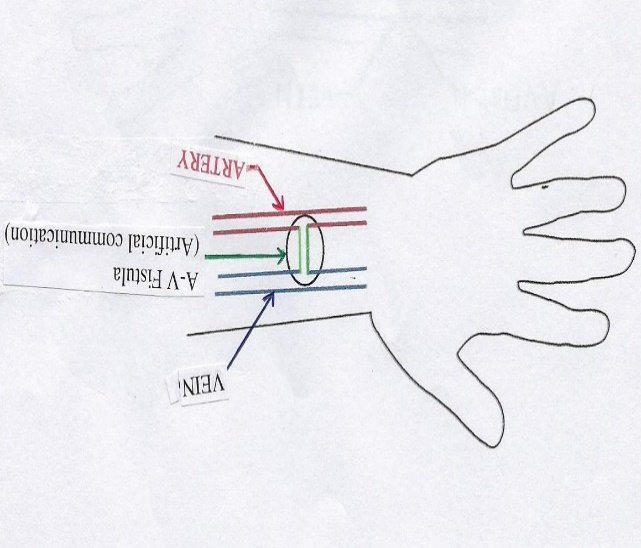
For kidney patients to perform dialysis without any obstacles, it is crucial to create a proper fistula in the upper limb. When a dialysis machine is regularly used to purify a kidney patient’s blood, the smooth functioning of the fistula becomes essential. During dialysis, a large amount of impure blood is extracted from the patient’s body through the vein and enters the dialysis machine, and after purification, it returns back to the body with the same speed. This means that during dialysis, the rapid and simultaneous exchange of blood in large amount occurs between the patient’s body and the dialysis machine. Normal veins in the patient’s arm are not suitable for this heavy and rapid exchange of blood because their walls are neither strong nor can they contain a large amount of blood. To strengthen these veins, the creation of a fistula becomes essential. Surgically connecting arteries and veins is called creating a fistula. A vascular surgeon uses a special surgical technique to create a fistula, the junction of arteries and veins.

Dr. K. K. Pandey is a Senior Consultant in Cardiothoracic, Thoracic and Vascular Surgery at Indraprastha Apollo Hospital, New Delhi, with nearly 30 years of surgical experience. He has previously worked at Batra Hospital, Dr. Ram Manohar Lohia Hospital in New Delhi and the Bakulev Institute of Cardiovascular Surgery in Moscow. Dr. Pandey specializes in thoracic, lung and chest tumour surgery, varicose veins, vascular bypass procedures and diabetic foot management, using both open and minimally invasive techniques. A surgeon, writer and health educator, he regularly writes columns and books to make complex medical topics easy for the general public, believing that medical knowledge must reach every common person.